Corealization
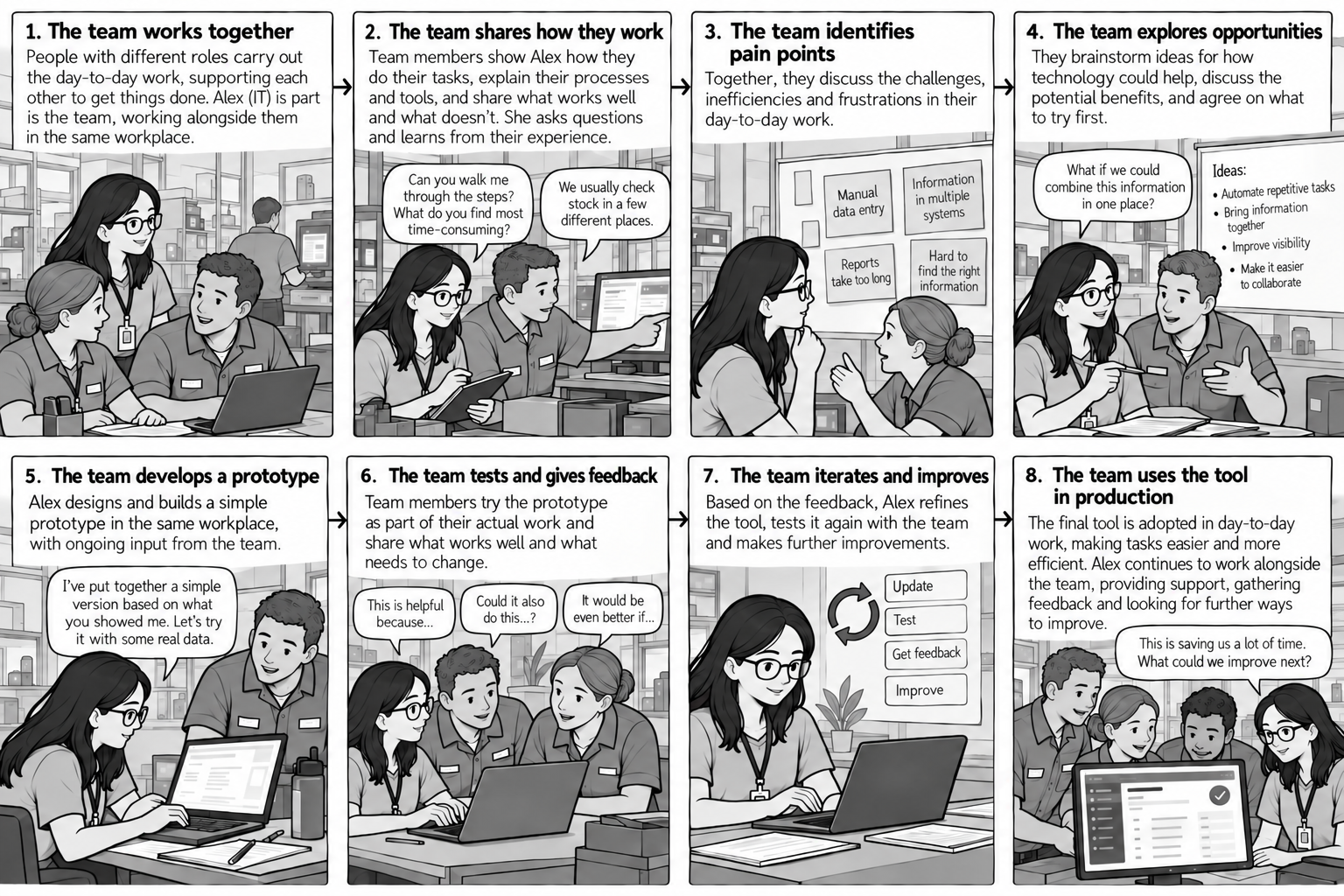
Corealization is an approach to developing systems that rolls discovery (what to build), rich prototypes (what would count as a solution), and the move to production (how to build and maintain it) into one process. It takes software development into the field, to where the users are.
Background
The idea of Corealization was developed in a small research group at Edinburgh University in the early 2000s. Affordable laptops and reusable software systems and components first enabled us to sit next to the people who would use the software and:
- directly observe what they were doing
- recognize the importance of activities otherwise taken for granted
- ask "stupid" questions
- identify problems and opportunities
- develop prototypes
- get feedback
- mature prototypes into working systems
Back then, the actual software development was the bottleneck and "agile" methods came to dominate software engineering because they made this process more efficient.
Corealization and generative AI
Today, with coding agents doing heavy lifting on the development side of things, questions like "what is worth building" and "how does the functionality support peoples' activities" move more into the foreground again.
Forward-deployed engineering is a term that comes up a lot - often in the context of an IT company's go-to-market strategy. However, some companies are starting to deploy their own IT staff as problem solvers embedded in other departments. This latter idea is much more in line with what we imagined Corealization to be.
With AI providing much of the expert knowledge required to generate even complex systems, people can focus on working together to identify real-world problems and to translate their understanding into instructions for coding agents. Automatically generated prototypes can be created at low cost (compared to human coding) and in timescales previously inconceivable. How much human effort is needed to turn these prototypes into production systems will depend on the context and the specific problem to be solved.
Coding agents for improved ends
What excites me about this is that we have a chance to use coding agents not just as a way to speed up development (to use them as improved means to unimproved ends, to invoke Thoreau) but to build systems that would not have been viable before. We can build uniquely adequate solutions to problems the IT industry did not see as important or profitable enough. We can free ourselves from being locked into proprietary file formats, costly subscriptions, and exploitative, enshittifying1 business models.
-
The term "enshittification" was coined by Cory Doctorow. ↩